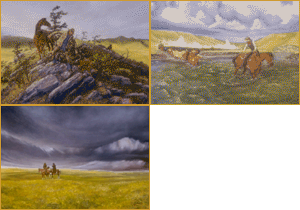
From time to time I will offer (for purposes of insight, amusement and revenge) a source explanation on paintings. Specific names and locations have been left out to save my hide.
The following explanations are an opinion, as are the paintings, of probability. The content is based on an experience and my perception of that experience. The integrity of both is in the eye of the beholder. One never wants to let the facts get in the way of a good story.
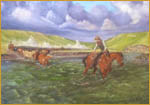
"Milk River Pull"
This painting is based on moving cattle up and down the Milk River valley. River crossings (even small ones) are a hazard to most domestic animals. Some times they need a little persuasion. In this case the story comes from discovering six or eight yearling steers stuck on an island.
It was June, it was cold, it was blowing and there was a ferocious current. After some debate, split along age lines, the old guys were sure the yearlings would starve to death. The young guys had a different opinion. The cattle were coming off. Now!
An attempt to get a couple of dogs over wasn't too successful.
Plan B. Two guys (old) take horse up stream. Strip to the cotton lederhosen and commence to a quick drift. It works! Sort of. The guys make it up the island cutbank. The horse is going down for the third time. Horse makes one last frantic scramble. One guy is pulling horse up, the other guy is running for his life as horse gains ground.
One guy on foot, other guy on horse, start hazing. Both modes are hard on feet and other sensitive areas. It doesn't work. Yearlings are starting to feel important.
Plan C. "Put a rope on and start pulling". Six laps later it's done, but there's just one small problem. How do you jump horse off of cutbank and pull at the same time without getting hung? Young guy (dry, dressed, and on shore) offers some advice- "Put another rope on" good idea! Young guy wades in on horse and spins loop out to island. Roped yearling stands on the slack while the ropes are connected. That's a bit of luck! Young guy dallies up, the steer feels the rope move and proceeds in the other direction as fast as four legs can move. CRAAA CK! The ropes hold. Steer and young guy communicate. A little more hazing, and the steers acquire swimming lessons on a pull, a plunge and a drift.
The old guys board horse for another swim, drift, whatever, put clothes back on, and we all get back to work.
The other source for this idea came from the same setting. Two of us (and a dog or two) were moving a couple of hundred, when it came time to cross. I was at the front, and after some pushing, pulling, and discussion of water levels and my skill level with a rope, common sense reared its ugly head. We opted for an extra couple of miles and the use of a plank bridge. Some adventures are better left as paintings.
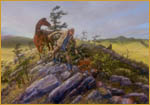
"Double Trouble"
Nobody likes to loose an animal and predation is never pretty. That said, it is necessary it's called earning a living. A predator like a grizzly is genetically programmed for ungulates in general. It's called survival.
While gathering one day up high amongst the ridges, the fellow I was following spotted a carcass under some spruce bows. Large predators will quite often attempt to hide a kill from scavengers while they feed off of it for a number of days.
While Lynn got off to get the tag number, I was left to have a good look around, not that it would have done either of us much good. A grizzly can cover the length of an average city lot in about three seconds. The way I got it figured, if you are lucky enough to see it coming, that is just about enough time for most us to kiss our horse's ass good by.
In this case the carcass wasn't much more than hide and hair. However, when the wind is blowing and you can't hear, sight lines are poor, and somebody else's dinner is on the plate, it is a good time to leave the rest of the adventure to a painting.
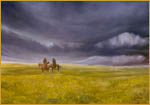
"Wind, Fire, Grass & Wildmen '
This painting is both a personal and a public story. It is an attempt to visually define those elements that have served to shape the environment I was born to and the people I claim to come from.
Of course now days most of the Great Northern Plains are packing the veneer of civilization and industrialization what with all the creature comforts at hand and wall to wall cultivation as a partner.
It wasn't always so, ride one of the larger pastures in bad weather, a fog or a whiteout and all of a sudden it can easily be a hundred years ago or even a thousand years ago.
It is the kind of environment where the drive to survive, without human constructs such as "sentimentality" "fairness" "kindness", requires a high degree of wildness or the power to endure, the power to persevere.
This wildness has now been pretty much bred out of both man and beast, but not entirely. Maybe that's a good thing. I know on the downside for civilized folk, it (the Great Plains environment) can, left to its own resources, very quickly rob a person of their humanity.
Not that long ago it very often did hence, the term wildmen . That is wildmen as in people who understand that nature confers life. No more no less. They also understand it is often up to them to make a Hobson's choice. Go mad or temporarily give up your humanity and hope you make it back.
Some days it is a lot easier just to make a painting.
|